"Do not be afraid; I am the first and the last, and the living one. I was dead, and see, I am alive forever and ever; and I have the keys of Death and of Hades. Now write what you have seen, what is, and what is to take place after this." Rev. 1:17-19.

Saturday, June 5, 2021

Following Jesus like a Toddler: A Baptism Sermon


On Friday night, our 14-month-old granddaughter spent the night alone at our house for the first time. (If we look sleepy today, we’re still recovering!)  She sure is a bundle of energy, darting across the room, launching herself backward off of the sofa, zooming for the steep staircase, climbing up a rickety chair … all with lighting speed. My reflexes were definitely no match for her powerful drive to explore.  The only time we could relax was when we had her contained somehow: either buckled up tight in her high chair, wrapped in my arms with a bottle, or asleep in her crib. If we tried to hold her safe for too long, though, that energy would burst its bonds in loud wails of protest. I’m sure that Henry’s family knows exactly what I’m talking about!

          For the writer of Mark’s Gospel, the whole world is crying out from bondage. It’s caught between two kinds of powerful energy: God’s energy of healing and Satan’s energy of destruction. For Mark, one or the other is constantly erupting in a flash of power, trying to subdue the other. It’s into this world of conflicting powers that Jesus bursts onto the scene, like a toddler into an unexplored room. In the sick whom he cures, in the teaching that he offers, in the demons that he challenges, Jesus wields God’s healing power like nothing anyone has seen before. Unlike the other teachers and healers who circulate around Capernaum, Jesus truly shakes up the balance of power in the world. He turns everything upside down! People are amazed, and at the same time, frightened. Who is this man who speaks and acts with such authority? Even his family doesn’t know what to make of him. Others worry how to tell whether Jesus is full of God’s power, or full of the power of God’s adversary, Satan.

          Today, passages like our Gospel lesson can be troubling. As Episcopalians, we don’t like to talk about Satan. We think in terms of medicine, psychology, and sociology, rather than in terms of personified cosmic forces. We don’t see our universe as engaged in a pervasive battle between God and the Devil. When I saw the readings for today, my heart sank. “Ugh,” I thought. “We have visitors this Sunday. We have a baptism for a cute little boy. Why do we have to hear about Satan today?!” Like the crowds around Jesus, I wished for a story where Jesus was acting just a little less wild. And then I remembered the renunciations and promises that Henry’s parents will make for him right after the sermon. Yes, in just a few minutes—we will renounce not just our own waywardness but also “Satan, and all the spiritual forces of wickedness that rebel against God” and “the evil powers of this world which corrupt and destroy the creatures of God.” Even our final song is about the devil! We can’t just seem to get away from Satan today!

Part of me wonders if all this devil talk is just outmoded imagery that we need to modernize. Deep down in my heart, though, I have trouble letting go of the living character of the evil that I have myself encountered in this world. I’ve led a pretty sheltered life. I’ve visited prisons but never been incarcerated; I’ve been in arguments, but not in wars; I’ve had health issues but not suffered from a debilitating sickness. Yet I have seen the creatures of God bound and shackled by powers that seem to have a life of their own. I’ll never forget, for example, walking away from my beautiful Gothic college campus at Sewanee, Tennessee, going through the woods and down a dirt path to the settlement of shacks that sat on church-owned land, less than a mile from my academic paradise. I’ll never forget looking into the innocent, intelligent blue eyes of three-year-old Jenny, a little girl at the Headstart Center there. I’ll never forget the chill that ran through me at the thought of the brightness of those eyes clouding over with a despair born of poverty, of the poverty right on my doorstep. Weren’t the chains that bound us each to our separate worlds an evil power that destroys the creatures of God? Didn’t Jesus come to free us from that power?

And what about the sweet, frail lady that I would visit at the hospital when I did my pastoral care training. Entirely alone in the world, without resources, wasting away with disease, in pain—this patient would lie there week after week, knowing that she would either die alone or return alone to an anonymous nursing home bed. Weren’t the chains that bound her to her solitude and sickness an evil power that destroys the creatures of God? Didn’t Jesus come to free her from that power?

And today, now that we have seen the knee on the neck of George Floyd, or the children in cages in ICE detention … How can we deny the existence of complex forces that keep us bound to racism and fear? How can we explain the pervasive denial of the humanity of those who differ from us? How can we explain our seeming inability to recognize and to honor the “eternal weight of glory” that is inside every single one of God’s creatures, beyond all measure? Aren’t those cords, wrapping us in fear of one another, an evil power that destroys the creatures of God? Didn’t Jesus come to free us from that power?

Evil is a power, I think, just like Love is a power. All of the myriad variations of our bondage to sin and death are powerful forces beyond our control, powerful forces worthy of the name of Satan, which really just means, “the Adversary:” the Adversary of the goodness and wholeness that God intends for creation. Jesus explains in our Gospel that this strong adversary, this “Strong Man,” can be bound with the even greater power of the Holy Spirit. Like a thief in the night, Jesus enters our world with this Holy Spirit power of Love and Healing. Binding the Strong Man, Jesus says, “Now, follow me.” Jesus asks us to follow him into the courageous work of freeing the captives and bestowing health and wholeness in our hearts, homes, and neighborhoods.[1]

Today, Henry is starting off on this journey with Jesus. When we mark Henry’s forehead with a sign of the cross, I will remind us all that he is sealed by the Holy Spirit in baptism and marked as Christ’s own forever. No evil power can bind him any longer, ever again. May he always follow Jesus in a joy-filled, curiosity-driven toddler way: throwing himself into Love with abandon, hurtling over prejudice and fear with courage; and burrowing headlong into caring relationships with the sick and lonely. And may we, his family in Christ, always be there to catch him when he falls. May we surround him not with restraints, but with the story of Jesus, the Powerful One who binds the Strong Man—the story of Jesus, who sets us free to do the work of love in the world.

 

Saturday, May 29, 2021

Table of Love


Long ago, as a newly divorced single mom, with children aged 2, 5, and 7, I found my way to an Episcopal church. While I might have looked on the outside as if I fit in, there probably weren’t many parishioners more lost, lonely, and spiritually desolate than I was. After each service, hungrier for adult companionship than for anything else, I would drag my squirming children to whatever fellowship opportunity was available. I grasped my toddler with one arm and balanced a cup of juice and a flurry of Sunday School coloring pages in the other hand. Alternately prodding and luring my whining older children with bribes of sweets, I would peer through the doors of the fellowship hall at the groups clustered around the tables. Invariably, I would find happy families and friends huddled together at small round tables, laughing, sharing smiles, turned toward each other in closed circles of complicity. There was little room for me and my rowdy bunch to slip smoothly into any group. Almost as a kind of dare, I would plop down at a totally empty table and busy myself with my children, waiting to see if anyone would join us. They rarely ever did.

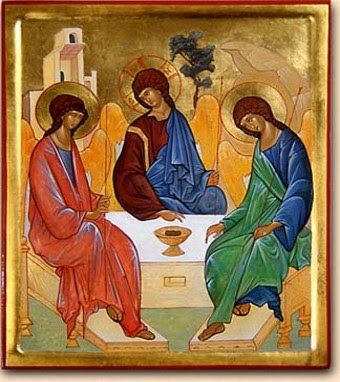
          I think that those difficult memories are why I am so fond of Rublev’s famous icon of the Trinity.  Rublev doesn’t paint the Trinity in the usual way. His is no portrait of a stately, white-bearded Father, elegant bare-chested Son, and chubby white Spirit-dove.

His is neither an attempt to portray a three-in-one-god,


nor make the Spirit female,


nor include the Virgin Mary in the mix!  


Rublev’s icon simply shows us three angelic figures sitting at a table.[1]

Called The Visitation of Abraham, this icon is based on the story from Genesis of God’s appearance as three messengers to Abraham and Sarah by the Oaks of Mamre. Abraham and Sarah welcome the strangers with open arms, bathing their feet and preparing a feast for them. As the men leave, they promise the aging couple that Sarah will soon give birth to a son. Interpreting the Old Testament allegorically, medieval Christians saw these three divine messengers as a manifestation of the Trinity.

The Russian icon-writer Rublev paints them as three figures with gender-neutral robes and hair-styles, seated around a table that holds a golden chalice. The central figure, who represents Christ, is holding his hand over the chalice in blessing, as the other two look on. What is most interesting about this icon is that there is both an openness and a swirling movement to it. Christ is neither looking down nor out at the viewer. Instead, he cocks his head clearly toward the figure to his right. That figure nods his head across the table to the other figure on his right, who, in turn, inclines his head back toward Christ. Even the wings and background objects bend as if caught in a gently turning, circular breeze.

The figures aren’t huddled around the table like the people in my old church fellowship hall, though. They aren’t focused only on their satisfying and already-established relationship. There is a clear break in the circle, a clear empty seat at the table right at the front of the icon, right across from Christ. Anyone who looks at this icon, automatically becomes the fourth person at the Table and is caught up in the circular fellowship of the other Three. This Trinity excludes no one from its conversation; as our whole congregation looks at this icon at once, we are all included at God’s Table.

When it comes to grasping the Trinity, we human beings are a lot like poor Nicodemus in today’s Gospel lesson: Standing there in the dark, trying to understand concepts that make no sense, yet wanting with all of our heart, mind, and soul to lay claim to the new life of Love that Jesus is offering us. We look at Jesus on the Cross; we look at God pouring Godself out in Creation; we feel the Holy Spirit bringing joy and transformation; we watch Jesus embrace sinners; we see miraculous healing; we taste forgiveness. We want to join them in these things. But how do we put it all together in our minds?

Left to our own devices, we tend to scoot our chair up close to Jesus, turning our backs to the world and gazing only into our Savior’s understanding face, as we try to imitate his every gesture. Or we dive only into the mystery of the Father, seeking rest and security in the darkness of God’s “eternal changelessness.” Or we abandon ourselves to the movement of the Spirit within ourselves, totally shutting our eyes to the equally powerful dance of suffering that is going on in the world outside. Or we give up all together on a Being who seems to watch the world ineffectually “from a distance,” and we go sit at a table by ourselves, busying ourselves with our human lives and daring God to join us.

The Doctrine of the Trinity reminds us that God is neither a changeless, distant object that we can view from across the safe emptiness of space, nor is God three friends before whom we can pull up a chair and visit individually according to our needs. If God is Love, then God must be movement, constant reaching out for the Other, constant exchange, constant and active relationship. Take a look at a few other images of the Trinity that artists have created for us, and perhaps the images can help us more than words can:

Look at the divine desire expressed by the Father in William Blake’s image, brooded over by the longing love of the Spirit.


Look at the energy that pulses through Hildegard of Bingen’s Trinity. The Word made flesh at the center, hands outstretched in vulnerability. The silver outer circle of the Father and the inner gold circle of the Spirit’s Fire, dancing around the Word with lines that suggest eternal movement.


Look at Marlene Scholz’s more recent Trinity, full of balanced downward and upward movement, surrounded with the whirl of the unknown.


In the 65th chapter of Isaiah, God cries out, “I was ready to be sought out by those who did not ask, to be found by those who did not seek me. I said, ‘Here I am, here I am,’ to a people that did not call on my name.” Can you imagine yourself peeking through the doors of heaven to see the Trinity sitting at the Table in the Great Celestial Fellowship Hall, Christ with his hand raised in blessing over a cup of his own blood, whispering a loving “here I am,” to the Father? Can you imagine the Father whispering, “Here I am” to the Spirit, who whispers, “here I am” back to the Son, round and round? For eternity, they wait and wait for us each to join them at the Table; they wait for us to share their cup; they wait for us to cry out in response to their longing, like the prophet Isaiah: “Here I am, send me!” They wait in love for us to join them, all so that their Love can flow out through us into the lonely spaces of our world.


[1] My description and analysis of this icon are based on Rowan Williams’ wonderful reflections in The Dwelling of the Light: Praying with Icons of Christ (Grand Rapids: William B. Eerdmans, 2003), 45-63. Other images of the Trinity are discussed in Sarah Coakley’s book, God, Sexuality, and the Self: An Essay ‘on the Trinity’ (Cambridge: Cambridge University Press, 2013.)